
Issue 470 · Season 2 · 2026-10-29
Genome-wide mapping of Cas9-induced sister chromatid exchange across single and over 200 genomic sites in human cells
✓ Verified · Factual 10/100:00Picture two decks of cards, identical in every way. Same cards, same order, ace to king. The only difference is the backs. One deck has blue backs, the other red. Now cut both decks at exactly the same card, and swap the halves. Turn them face up, and nothing has changed. Every card is still in perfect order. Turn them face down, and the swap jumps out at you. Blue gives way to red, right at the cut. Now ask yourself: what if your cells do this to their own chromosomes every time we edit them?
0:38This is Base by Base. Every episode is built with AI tools from a real, open-access paper, curated by a human, and every claim is checked against the paper before we publish. You'll find this episode's fact-check score on our website. Now, back to the story.
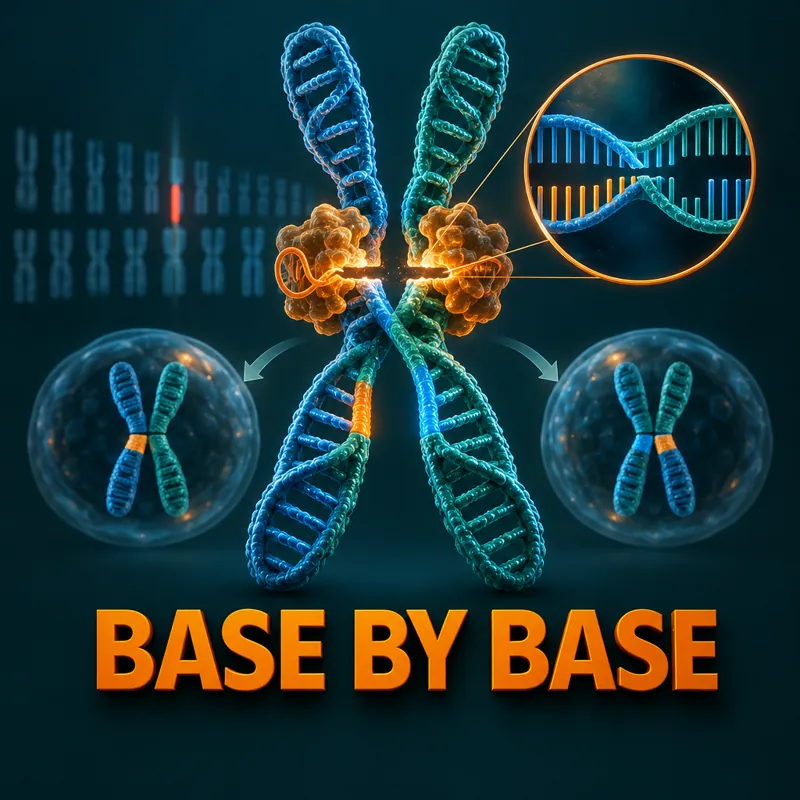
0:59Here is why that question matters. When a cell copies a chromosome, it makes two identical sisters, joined in the middle. If one sister breaks, the cell can repair it by trading pieces with the other. Because the sisters are identical, the trade changes no DNA letters at all. It is the face-up deck. Standard sequencing reads only the letters. So it cannot see the swap. To see it, you need a way to look at the backs of the cards.
1:30And the scissors in this story are the most famous ones in modern biology. Cas nine cuts DNA at a site chosen by a short guide. Labs use it every day to switch off genes. We usually judge an edit by what it leaves behind at the cut, a few letters added or lost. But what if many cuts are repaired by a silent swap between sisters instead? And what if some of those swaps are not as clean as they look? How would anyone know?
2:04Today, we celebrate the work of Peter Chovanec, Shiyang He and Yi Yin, from the Department of Human Genetics at the David Geffen School of Medicine, U C L A, who have advanced our understanding of how cells repair the cuts we make in them. This Base by Base episode is based on their open access article, Genome-wide mapping of Cas nine induced sister chromatid exchange across single and over two hundred genomic sites in human cells, published in eLife in October 2026.
2:40Let's start with the cut itself. Cas nine makes a double-strand break, a clean snap through both strands of the helix. The cell then has to fix it. Two repair routes are best known. End joining glues the ends back together, and often adds or removes a few letters. That is how most gene knockouts happen. Homologous recombination copies the missing information from a matching template. In the lab, that template can be a piece of donor DNA, which allows a precise edit. Both routes have been studied in detail, letter by letter.
3:17For years, those small local changes were the whole story. Then the picture got bigger. Earlier work, cited by the authors, found large deletions spanning kilobases at the cut site. Other studies found that these breaks can shatter a chromosome entirely. In edited human embryos, whole chromosomes and large segments were lost. And in edited cancer cell lines, rearrangements were often missed by the usual P C R checks. So the scissors can do far more than nick a few letters. But one outcome stayed largely overlooked.
3:54That outcome is sister chromatid exchange. The authors define it simply, as a reciprocal strand switch between the two sister chromatids. They are careful not to tie it to one mechanism. It can come from recombination between sisters. It can also come from end joining across two breaks, one on each sister. Why would that happen here? Because Cas nine usually cuts both sisters at the same spot. That leaves four broken ends, and neither sister intact.
4:27Now think about how those four ends can be rejoined. If each sister is glued back to its own ends, the original arrangement returns. If the top of one sister is joined to the bottom of the other, you get a strand switch. Put another way, the decks were cut and the halves swapped. And that switch looks exactly like a classic recombination exchange. Which of these routes produces the exchanges we see had not been determined.
4:57So three questions were open. Does a single targeted break efficiently trigger a local exchange? What happens when hundreds of sites are cut at once? And are these exchanges always error-free, or do some hide structural damage? Answering any of them means seeing something that leaves no trace in the sequence. That is the gap this study set out to fill.
5:25How do you see the backs of the cards? The team used a method called sci L three Strand-seq, a single-cell form of template-strand sequencing. Here is the trick. While a cell copies its DNA, it is fed a modified building block called B r d U. The new strands soak it up. The method then destroys those new strands, and sequences only the old parental ones. Each parental strand runs in one of two directions, called Watson and Crick.
5:58Those two directions are the blue and red backs of our cards. Along a normal chromosome, a daughter cell inherits one direction for the whole length. If the direction flips partway along, that flip marks an exchange. No letter has to change. The method reads the pattern of the backs, cell by cell, across the whole genome. And because it handles many cells at once, it can sometimes capture both daughters of the same division. The authors call those reciprocal daughter-cell pairs. With both daughters in hand, you can check whether a trade was really clean.
6:34Now the experiment itself. The team delivered Cas nine as a ready-made complex of protein and guide, a common way to make knockouts. They worked in two human cell lines. Four guides each cut a single unique site, inside a DNA repair gene. Those genes were L I G three, L I G four, X R C C one and X R C C four. A fifth guide matched a repetitive Alu sequence, and cut two hundred thirty-seven sites at once.
7:08The timing matters here. In one setup, the scissors and the label went in together for twenty-four hours. So the cut and the labeling happened in the same cell division. In the other, the scissors were washed out first, and the label added afterwards, to read the next division. The team also tested two nickases, versions called D ten A and H eight four zero A. Each of them cuts only one strand of the DNA instead of both. They were built to be gentler.
7:42The first result came before any sequencing. Cutting with full Cas nine, at one site or at the repetitive targets, caused a pronounced arrest within twenty-four hours. Even a single break was enough to trigger it. That arrest lasted after the scissors were removed only in cells hit at the repetitive sites, consistent with damage piling up across many places at once. The two nickases, by contrast, did not measurably disturb the cell cycle after washout. One cut strand was largely tolerated. Two cut strands were not.
8:19Then the main question. Where do the exchanges land? The team stacked up every exchange from every single cell across the genome, in windows of one megabase. For all four single-site guides, exchanges piled up right at the programmed cut. The signal was strongest in the first division after delivery, and weaker after washout. So a single targeted break turns out to be a potent local trigger of sister chromatid exchange.
8:49How strong? The combined on-target exchange rate reached forty-one percent in the first division. Forty-one percent. Nearly half the cells. In the following division, after washout, it reached seventeen percent. Overall the rate dropped by about half after washout, with the largest drop at seventy-four percent. The authors note these exchanges happen at frequencies comparable to the small insertions and deletions normally used to measure editing. Yet standard sequencing does not see them at all.
9:24There is an obvious objection here. Cas nine delivered this way edits around ninety percent of cells in bulk. So is forty-one percent just a measure of editing? The authors say no. The scissors can cut the same site many times, with repair in between. So the number should not be read as knockout efficiency, or as the rate of error-free repair. It measures something narrower. It is the share of breaks repaired by trading with the sister, rather than being fixed on the same chromatid.
9:58Next, a check on the four target genes. They were all DNA repair genes. Would breaking them raise exchange everywhere in the genome? Not right away. All four conditions showed a median of three exchanges per cell, the same as untreated cells. The reason is timing. Even when both copies of a gene are disrupted, the protein already in the cell does not vanish. It has to be diluted away through turnover and cell division before anything changes.
10:30Now the harder experiment. What happens when you cut two hundred thirty-seven sites at the same time? You might expect exchanges everywhere. That is not what the data show. Across all cells, the enrichment at the targeted sites was mild. In the strongest condition, after washout, exchanges fell at the cut sites one point two zero times more often than at random spots, in two thousand five hundred forty-seven cells. That worked out to about six point one three on-target exchanges per cell. Real, measurable, but modest.
11:08And that is where it gets complicated. The average hid something. When the authors looked only at cells carrying an unusually high number of exchanges, the picture sharpened. In that subset of two hundred sixty-one cells, the enrichment rose to one point three nine, with an average of fourteen point six one on-target exchanges per cell. So most cells repaired their cuts some other way, without trading. A minority engaged the trade heavily. The nickases, meanwhile, showed no meaningful enrichment at all.
11:44Even in those busy cells, something is worth noticing. The number of on-target exchanges per cell stayed below fifteen, far fewer than the two hundred thirty-seven sites available to cut. So most of those sites either were never cut, or were repaired by a route that leaves no exchange. The authors cannot say which, and they do not pretend to. They offer two possibilities: a cell-cycle state that favours both cutting and recombination, or simply chance in how much of the enzyme each cell took up.
12:19Which brings us to the sharpest result. Remember the reciprocal daughter-cell pairs, where both halves of a division are captured. If an exchange is a clean trade, the two daughters should mirror each other exactly, with no DNA gained or lost. In a companion study on spontaneous exchanges, that is precisely what happened. Eighty-seven out of eighty-seven were reciprocal and copy-neutral. Every single one. So the trade can be perfectly clean.
12:50With Cas nine, it often was not. Among the exchanges recovered from these daughter pairs, fourteen of fifty came with large structural changes alongside them. In one pair, one daughter carried a strand switch at a junction, while the other carried a deletion at the matching spot. Go back to our decks. The halves were swapped, but one deck came back with cards missing. And you would never know by reading the faces.
13:21So what does this change? First, how we judge an edit. Editing is usually measured by sequencing a small window around the cut, or the whole genome. Neither sees a swap between identical sisters, and neither sees these junction changes. The authors argue that single-cell, strand-level resolution is needed for a full accounting of what programmable scissors leave behind. But we should note the limitation right here. Every experiment was done in ordinary, unmodified cells, and in two cell lines only.
13:57Second, the shape of the break matters. When both sisters are cut at the same place, neither one is left intact to serve as a clean template. The authors call this geometry isochromatid. It is structurally different from the breaks that arise on their own during copying, where one good sister is always available. And that difference shows up in the results, as a measurable fraction of outcomes that carry damage.
14:25Third, a mechanistic hint, and this one needs care. That pattern of a strand switch in one daughter and a deletion in the other does not fit classical recombination. It does fit a different route, in which regions of the chromosome that were never finished copying get cut and stitched back together. Recent work has linked that route to a specific set of proteins. The authors say their observation is consistent with that mechanism. They do not say it proves it.
14:56And the reason for that caution is simple. That signature was seen in a single daughter-cell pair. One. The authors state the limit plainly in the paper. A single observation can point toward a mechanism; it cannot establish how often it happens, or in which cells. Testing that will need many more pairs, and conditions where the proposed route is deliberately disabled.
15:22There is one more honest caveat, and it is about causation. Cas nine can cut the same spot over and over, with repair in between. So when a rearrangement shows up, it cannot be pinned to one cleavage event. The authors say this directly, and it limits what any single outcome can tell us. Tighter control over when the enzyme acts, and how many times, is what the next round of experiments will need.
15:51So here is where this leaves us. A single Cas nine cut is a potent trigger of exchange between sister chromatids, reaching forty-one percent in the first division. Cutting hundreds of sites at once gives only a mild effect overall, concentrated in a minority of cells. And these exchanges are not uniformly benign: fourteen of fifty came with structural changes attached, against eighty-seven of eighty-seven clean ones when the exchange arose on its own.
16:22Remember the two decks of cards. Read the faces, and the swap is invisible. Read the backs, and it is obvious, along with the cards that went missing. We have been reading the faces. What does this mean for the future of gene editing, if the most common outcome of a cut is one we have not been measuring?
16:48This episode was based on an open access article under the C C B Y four point zero license. You can find a direct link to the paper and the license in our episode description. If you enjoyed this, follow or subscribe in your podcast app and leave a five-star rating. If you'd like to support our work, use the donation link in the description. Thanks for listening, and join us next time as we explore more science, base by base.
Watch
Watch on YouTube ↗
Paper
When CRISPR/Cas9 cuts DNA, editing is usually judged by the small insertions and deletions left at the break. But a cut can also be repaired by swapping DNA between the two identical sister chromatids, an exchange that leaves no sequence change and is invisible to standard sequencing. Using sci-L3-Strand-seq, a single-cell method that reads which parental template strand each daughter cell inherited, this study mapped Cas9-induced sister chromatid exchange (SCE) in human cells, after cutting either one unique site or 237 repetitive Alu sites at once.
LicenseCC BY 4.0
QC Report
The paper, claim by claim.
Every episode is audited against the original paper before publication. Numbers, mechanisms, and verbal claims are checked one by one.
Factual
10/10
Metadata
10/10
Listen & subscribe
 Cancer treatment alters mutant selection in normal esophagus
Nature Genetics✓ Verified · 10/10
 A haplotype reference panel constructed from 490,319 UK Biobank genomes improves genotype imputation for global populations
Nature Genetics▲ With notes · 10/10
 Accurate detection of sub-1% frequency somatic mutations by whole-genome sequencing
The American Journal of Human Genetics✓ Verified · 10/10
 A massively parallel reporter assay of MECP2 cis-regulatory elements reveals genetic candidates for male-biased autism
The American Journal of Human Genetics✓ Verified · 10/10