
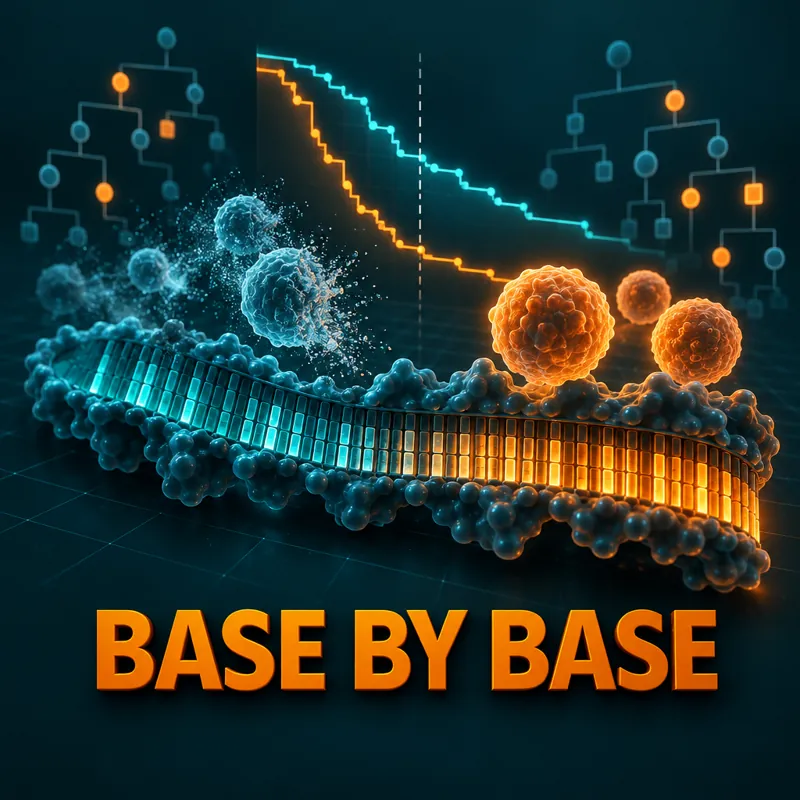
Issue 475 · Season 2 · 2026-11-05
Deep CRISPR mutagenesis predicts cancer risk in Li-Fraumeni syndrome
✓ Verified · Factual 10/100:00People can carry a disease-causing change in the same gene and still show very different clinical pictures, from mild to severe. Some meet the clinical criteria for a hereditary cancer syndrome. Others do not. The gene is T P fifty-three. The syndrome is called Li-Fraumeni syndrome, and it brings a lifelong increased risk of many solid tumors, as well as cancers of the blood. So why would the same gene behave so differently? And could a measurement made in cells in a dish help tell which carriers face the higher risk?
0:35The answer matters for a practical reason. A cancer surveillance protocol has been shown to significantly improve long-term survival in people with Li-Fraumeni syndrome. To adjust such measures to the actual risk, estimating different levels of cancer risk is of critical importance. Today's study asks whether a single number, measured in a laboratory screen of thousands of T P fifty-three mutations, can help make that adjustment.
1:06This is Base by Base. Every episode is built with AI tools from a real, open-access paper, curated by a human, and every claim is checked against the paper before we publish. You'll find this episode's fact-check score on our website. Now, back to the story.
1:27Today, we celebrate the work of Judith Penkert, Anika Grosshennig, Christian Kratz and colleagues, from Hannover Medical School in Germany, who have advanced our understanding of cancer risk in Li-Fraumeni syndrome. This Base by Base episode is based on their open access research letter, "Deep CRISPR mutagenesis predicts cancer risk in Li-Fraumeni syndrome", published in The American Journal of Human Genetics in 2026.
1:56Start with the gene. T P fifty-three encodes a transcription factor, also called T P fifty-three. It controls genes involved in the cell cycle, in apoptosis, which is programmed cell death, and in senescence. It also touches stem cell differentiation, metabolism and D N A repair. About fifty percent of all human cancers carry somatic T P fifty-three mutations. When a disease-causing variant is in the germline instead, or is a postzygotic somatic mosaic, the result is Li-Fraumeni syndrome.
2:31The increasing use of genetic sequencing in clinical medicine has revealed a wider picture. Carriers of pathogenic or likely pathogenic T P fifty-three variants show a range of mild to severe clinical phenotypes. They do not always meet the clinical genetic testing criteria, called the Chompret criteria. This led to a classification called the Li-Fraumeni spectrum. Carriers who meet the criteria are said to have Li-Fraumeni syndrome. Carriers who do not are said to have attenuated Li-Fraumeni syndrome.
3:05What decides where a carrier falls? Several things are known to matter. There are genetic modifiers and environmental factors, such as genotoxic cancer therapies. There are the neoantigenic properties of the variant. And there is the function of the variant itself. Null variants, predicted to make no protein at all, and other severely impaired variants are significantly associated with the full syndrome. Variants with milder functional disruption are associated with the attenuated form. So the question becomes how to measure that disruption well.
3:42This is where an earlier study comes in. It used deep CRISPR mutagenesis to map the functional diversity of mutations in the D N A binding domain of T P fifty-three. A total of 9,225 different mutations were introduced into a colorectal cancer cell line. The mutant cells were then treated with different T P fifty-three activators. Cells with benign variants underwent apoptosis and died. Cells with pathogenic variants survived.
4:13Next-generation sequencing counted which mutants survived, and the result for each one was expressed as a relative fitness score. Synonymous mutations, which do not change the protein, were mostly benign, with a median score of minus one. Nonsense mutations, frameshift insertions or deletions, and in-frame deletions were mostly pathogenic, with a median score of plus one. Missense variants, which swap a single amino acid, spread across a broad range of scores.
4:46The Hannover team turned to patients. They analyzed a cohort of seven hundred and twenty-eight individuals with Li-Fraumeni syndrome, from two hundred and forty-eight families, enrolled in the German Cancer Predisposition Syndrome Registry. For four hundred and thirty-seven individuals from one hundred and sixty-eight families, three things were available together. The underlying T P fifty-three variant, proven or inferred from the pedigree. Its relative fitness score. And survival data. The question was whether the score could predict cancer risk.
5:26To compare carriers, the authors used Kaplan-Meier analysis of cancer-free survival time, the time each person lived before a first cancer. They estimated an optimal cut-point for the score, based on time to first malignancy. That cut-point was zero point six seven three. The result was clear. Carriers of variants scoring zero point six seven three or higher developed cancer significantly earlier than carriers of variants scoring below it.
5:56How large was the difference? A score below the cut-point was associated with significantly longer cancer-free survival, with a hazard ratio of zero point four one. The ninety-five percent confidence interval ran from zero point two five to zero point six six. The p value was zero point zero zero zero two. In this analysis, a lower score went with a later first cancer.
6:25There was an obvious objection. Null variants are already known to carry a high cancer risk. Perhaps they alone were driving the curves. So the authors ran a separate analysis without them. Among the remaining four hundred and seven individuals, whose variants are predicted to produce an altered protein, the pattern held. The hazard ratio was zero point four three, with a p value of zero point zero zero zero five. None of these individuals had been pretreated with genotoxic therapies, and sex did not influence the results.
7:00The authors then looked at families. Across all one hundred and sixty-eight families with an available score and sufficient clinical data, they asked whether the score predicts clinical severity within the Li-Fraumeni spectrum. Families with a score of zero point six seven three or higher met the definition of the full syndrome in one hundred and ten out of one hundred and forty-eight families. That is seventy-four point three percent. Among families with a lower score, only three out of twenty met it. Fifteen percent.
7:35As a ratio, families with a high score were about five times as likely to meet the full definition, a relative risk of five point zero. Families with a low score were more likely to meet the criteria of the attenuated form. The authors suggest that these scores can be incorporated into future variant classification algorithms. The aim is to identify variants with atypical penetrance, and so enable tailored cancer surveillance. They also see a broader lesson: deep CRISPR mutagenesis can be used to predict the clinical severity of a genetic condition.
8:12The authors list three limitations. First, the differences in cancer-free survival were not validated in independent cohorts, although the cohort was large and the differences were substantial and biologically plausible. Second, the scores were established in a single colorectal cell line, and cell-type specificity cannot be ruled out. Third, scores are currently not available for mutant proteins with changes outside the D N A binding domain.
8:44So here is where this leaves us. A laboratory screen scored thousands of T P fifty-three mutations by whether cells carrying them survived. In four hundred and thirty-seven people with Li-Fraumeni syndrome, a score of zero point six seven three or higher was associated with an earlier first cancer, and families with high scores more often met the criteria for the full syndrome. The letter is dedicated in memory of Joseph F. Fraumeni Junior. What would it take for a cell score like this to guide the surveillance plan of a real family?
9:21This episode was based on an open access article under the C C B Y four point zero license. You can find a direct link to the paper and the license in our episode description. If you enjoyed this, follow or subscribe in your podcast app and leave a five-star rating. If you'd like to support our work, use the donation link in the description. Thanks for listening, and join us next time as we explore more science, base by base.
Watch
Watch on YouTube ↗
Paper
Carriers of disease-causing TP53 variants range from mild to severe cancer phenotypes. Using relative fitness scores from a deep CRISPR mutagenesis screen of 9,225 TP53 mutations, this registry study of 437 individuals from 168 families shows that variants scoring 0.673 or higher go with earlier cancer and with full Li-Fraumeni syndrome.
LicenseCC BY 4.0
QC Report
The paper, claim by claim.
Every episode is audited against the original paper before publication. Numbers, mechanisms, and verbal claims are checked one by one.
Factual
10/10
Metadata
10/10
Listen & subscribe
 Cellular senescence: six decades of discovery and reinvention
The EMBO Journal✓ Verified · 10/10
 Cancer treatment alters mutant selection in normal esophagus
Nature Genetics✓ Verified · 10/10
 Shared inheritance reveals landscape of somatic and germline cancer risk in TP53
The American Journal of Human Genetics✓ Verified · 10/10
 Prion protein lowering is a disease-modifying therapy across prion disease stages, strains and endpoints
Nucleic Acids Research✓ Verified · 10/10